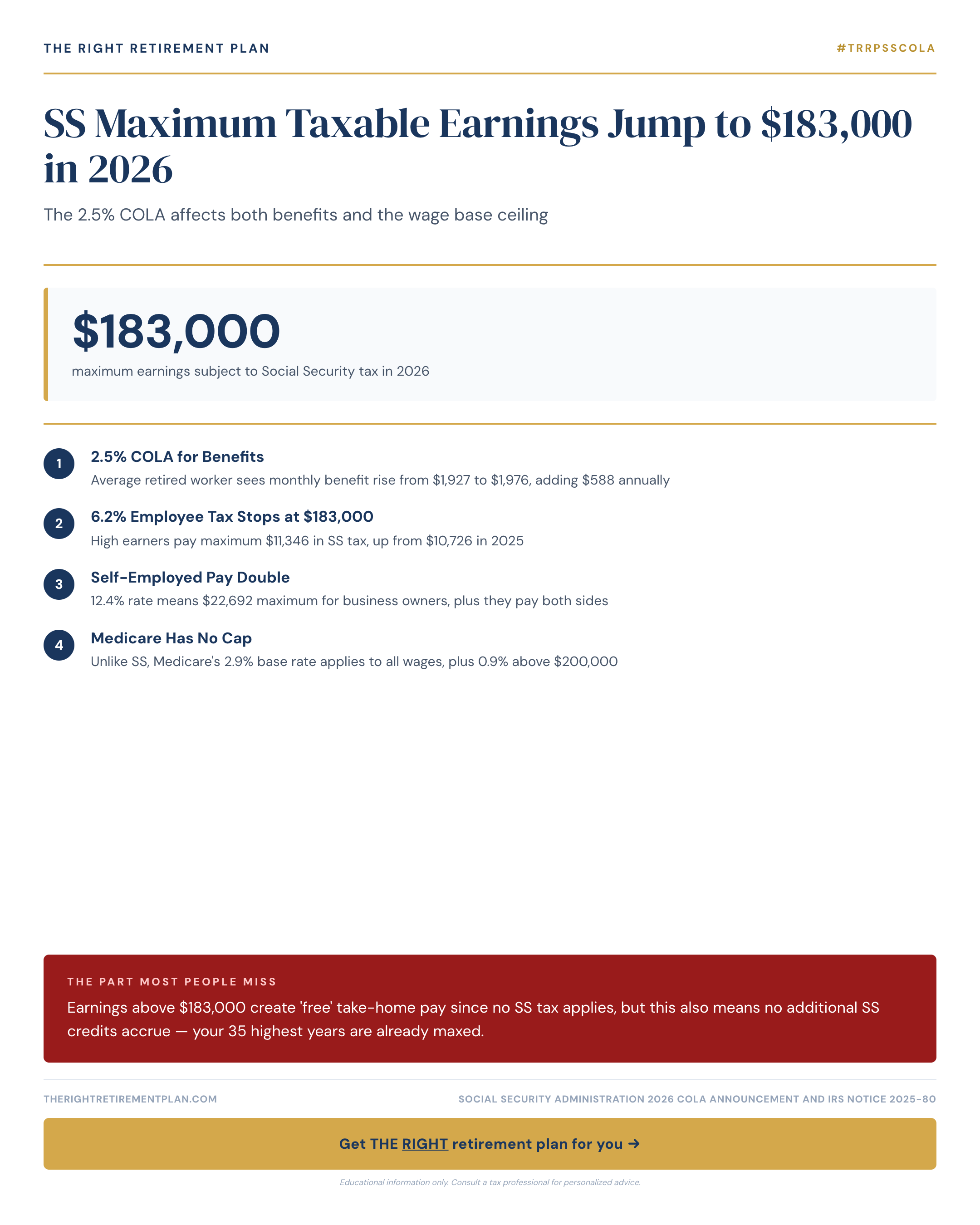
The Social Security Administration announced that the maximum taxable earnings for Social Security will increase to $183,000 in 2026, up from $176,100 in 2025. This 3.9% jump reflects the automatic adjustment based on national wage growth and affects millions of American workers, particularly those in higher-income brackets.
How the Social Security Wage Base Works
The Social Security wage base represents the maximum amount of earnings subject to Social Security taxes each year. In 2026, you'll pay the 6.2% Social Security tax on your first $183,000 of wages or self-employment income.
Here's what this means practically:
- Earnings up to $183,000: Subject to Social Security tax
- Earnings above $183,000: No Social Security tax applied
- Maximum annual Social Security tax: $11,346 (6.2% × $183,000)
For Maryland retirees and high earners across the Mid-Atlantic, this creates an interesting dynamic. Once you exceed the wage base, your additional earnings become "tax-free" from Social Security's perspective, effectively increasing your take-home pay on income above the threshold.
The Credit Limitation You Need to Know
While earning above $183,000 means no additional Social Security taxes, it also means no additional Social Security credits. Your benefit calculation uses your highest 35 years of earnings, but those years are capped at each year's maximum taxable amount.
This creates a plateau effect:
- Someone earning $183,000 gets the same Social Security credits as someone earning $300,000
- Both workers reach the maximum possible benefit calculation for that year
- Additional earnings don't boost future Social Security benefits
Strategic Implications for Retirement Planning
Understanding the Social Security maximum taxable earnings helps with retirement planning decisions. High earners should focus on maximizing other retirement vehicles once they hit the wage base ceiling.
Consider these strategies:
- Maximize 401(k) contributions (limit increases to $24,000 in 2026 for those under 50)
- Explore Roth IRA conversions during lower-income years
- Evaluate tax-deferred versus tax-free retirement accounts
Getting Social Security planning wrong can cost tens of thousands over retirement, but these mistakes are completely avoidable when you understand how the system actually works.
If you want personalized guidance on how the 2026 changes affect your specific retirement strategy, consider taking our free Retire Ready Score assessment.