How the Step-Up in Basis Rule Works
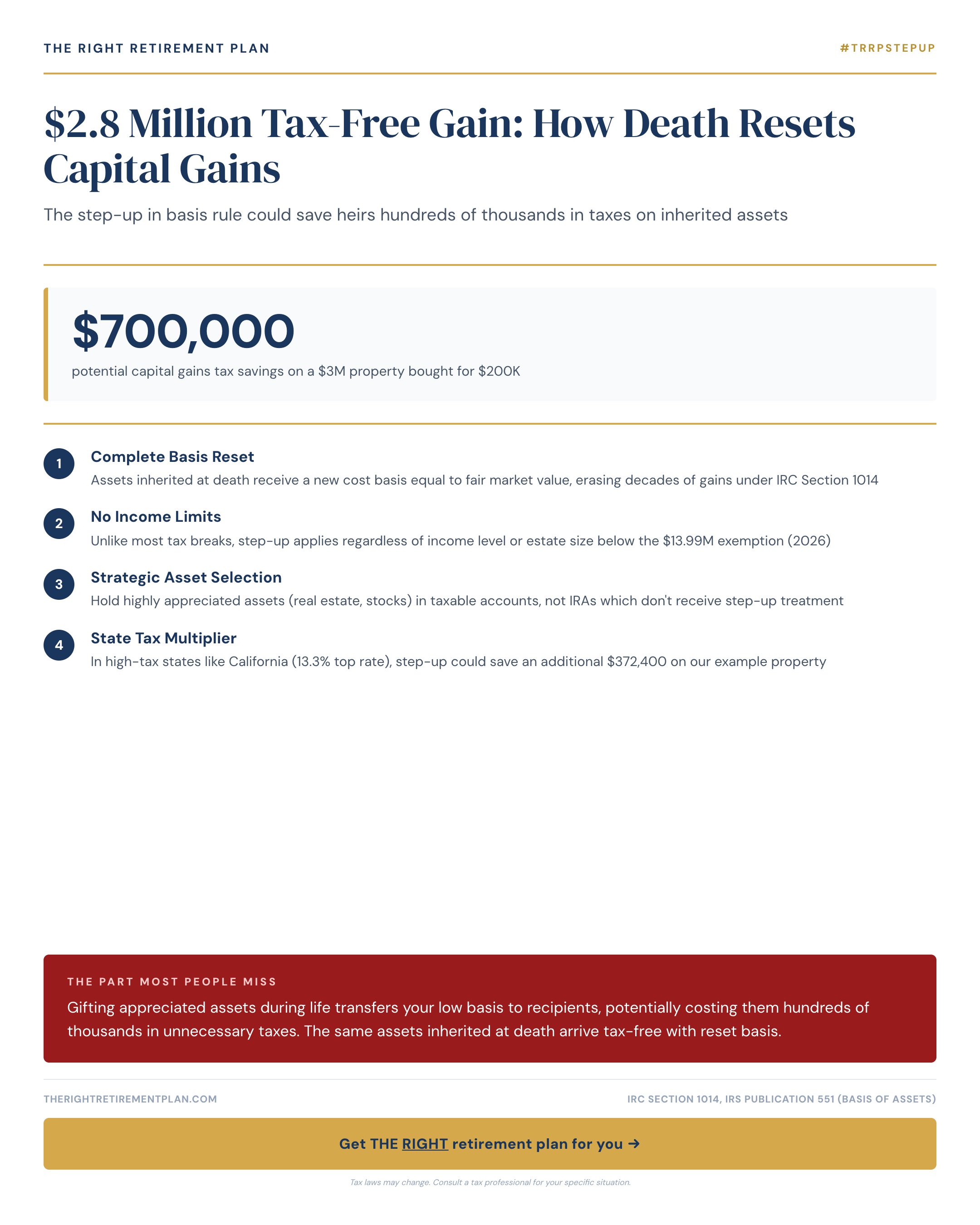
When you inherit assets like stocks, real estate, or mutual funds, the IRS essentially "resets" their cost basis to the fair market value at the time of the original owner's death. This step-up in basis rule can create enormous tax savings for beneficiaries.
Here's a powerful example: Say your parent bought Apple stock for $10,000 in 1990, and it's worth $2.8 million when they pass away in 2026. If they had gifted you that stock while alive, you'd inherit their $10,000 basis and owe capital gains tax on $2.79 million when you sell. At current rates, that's potentially $558,000 in federal taxes alone.
But if you inherit the same stock at death, your new basis becomes $2.8 million. Sell it immediately? Zero capital gains tax.
Gift vs. Inheritance: The Million-Dollar Difference
This creates a critical planning decision for retirees. Gifting appreciated assets during your lifetime might seem generous, but it transfers your low cost basis to recipients. They'll face the full tax burden when they eventually sell.
Maryland retirees with significant appreciated assets need to weigh this carefully. The annual gift tax exclusion for 2026 is $19,000 per recipient, making it tempting to gift stocks or real estate. But those gifts could cost your heirs substantially more than waiting.
Consider these strategies instead:
- Hold highly appreciated assets until death when possible
- Gift cash or newer investments with smaller gains
- Use retirement account distributions for lifetime gifts
- Consider charitable remainder trusts for large estates
When Gifting Still Makes Sense
The step-up rule isn't absolute. Gifting can work when assets have minimal appreciation, when you need to reduce estate size for tax purposes, or when recipients are in lower tax brackets and plan to sell soon.
For 2026, federal estate tax only applies to estates exceeding $13.99 million per person. Most families won't hit this threshold, making the step-up strategy even more valuable.
Getting estate planning details wrong can cost families hundreds of thousands in unnecessary taxes. The good news is these mistakes are completely avoidable with proper planning and understanding of how these rules actually work.
If you want to see how the step-up in basis rule applies to your specific situation, consider taking our free Retire Ready Score for personalized guidance.