Why Early Market Drops Hit Retirees So Hard
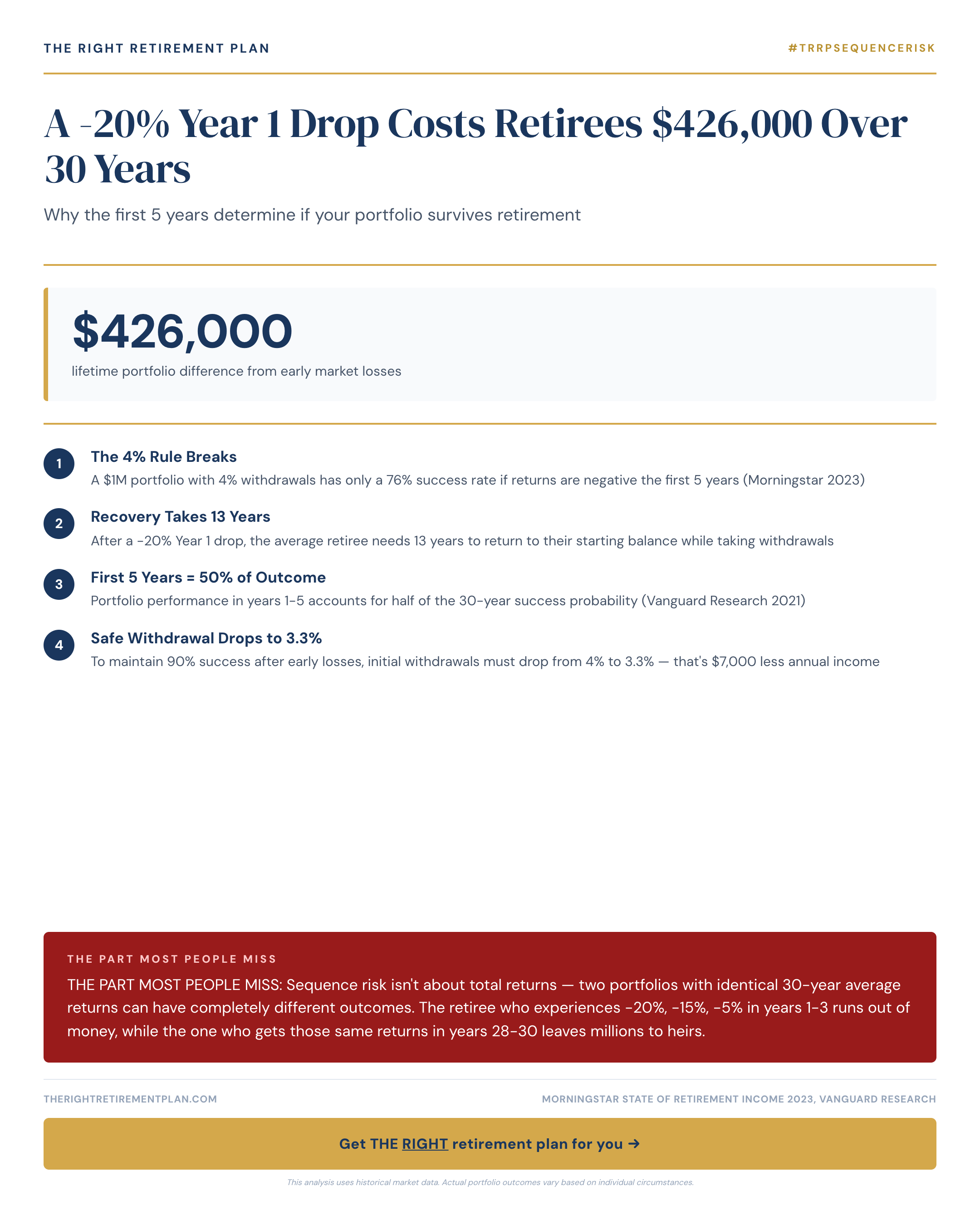
You've reached retirement with a solid nest egg, but timing still matters—perhaps more than you realize. A 20% market decline in your first year of retirement could cost approximately $426,000 over 30 years compared to experiencing that same drop in year 25, according to research from the Center for Retirement Research at Boston College.
This devastating math comes down to sequence of returns risk—the danger that poor market performance early in retirement can permanently damage your portfolio's ability to sustain withdrawals. When you're drawing income from investments, the order of returns matters just as much as the average.
Here's the crucial difference: during your working years, market drops hurt but you have time to recover through continued contributions. In retirement, withdrawals during downturns force you to sell more shares at depressed prices. Those shares are gone forever and can't participate in future recoveries.
The Mathematics of Retirement Timing
Consider two retirees, each starting with $1 million and withdrawing $40,000 annually (adjusted for inflation):
- Retiree A faces -20%, -15%, -5% returns in years 1-3, then averages 8% annually
- Retiree B experiences those same losses in years 28-30, with 8% returns early on
Both have identical 30-year average returns of 6.2%. Yet Retiree A's money runs out by year 22, while Retiree B finishes with over $2.1 million.
The difference lies in forced selling during downturns. When Retiree A withdraws $40,000 from a portfolio that's dropped to $800,000, they're liquidating 5% of remaining assets. When Retiree B makes that same withdrawal from a portfolio worth $3.2 million, they're selling just 1.25%.
Key insight: For Maryland retirees and others nationwide, protecting against early losses may be more valuable than chasing higher average returns.
Strategies to Protect Your Vulnerable Years
The first five years of retirement—what researchers call the "fragile decade"—demand special attention. Here are defensive strategies many financial advisors recommend:
Build a Cash Buffer
- Maintain 2-3 years of expenses in money market funds or short-term bonds
- Draw from this buffer during market downturns instead of selling stocks
- With 2026 projected yields above 4%, this strategy is less costly than during low-rate periods
Consider Flexible Withdrawals- Reduce spending 10-15% during down markets
- Research shows this flexibility can significantly improve portfolio survival rates
- The rigid "4% rule" assumes constant withdrawals regardless of conditions
Delay Social Security When Possible- Benefits increase 8% annually between full retirement age and 70 for 2026
- Creates guaranteed income floor that reduces portfolio withdrawal needs
- Use investment withdrawals early while building this larger benefit base
This mathematical reality means stability has measurable value once you're depending on your portfolio for income. Understanding this principle could fundamentally change how you structure your early retirement years.
---
If you're curious how sequence of returns risk might affect your specific situation, consider taking our Retire Ready Score for personalized insights into your retirement readiness.