Why Your Roth Conversion Today Shows Up in Your Medicare Bill Two Years Later
You've calculated the tax benefits of Roth conversions and identified those golden years between retirement and required distributions as your conversion window. But there's a hidden cost that catches even experienced planners off-guard: Medicare's Income-Related Monthly Adjustment Amount (IRMAA).
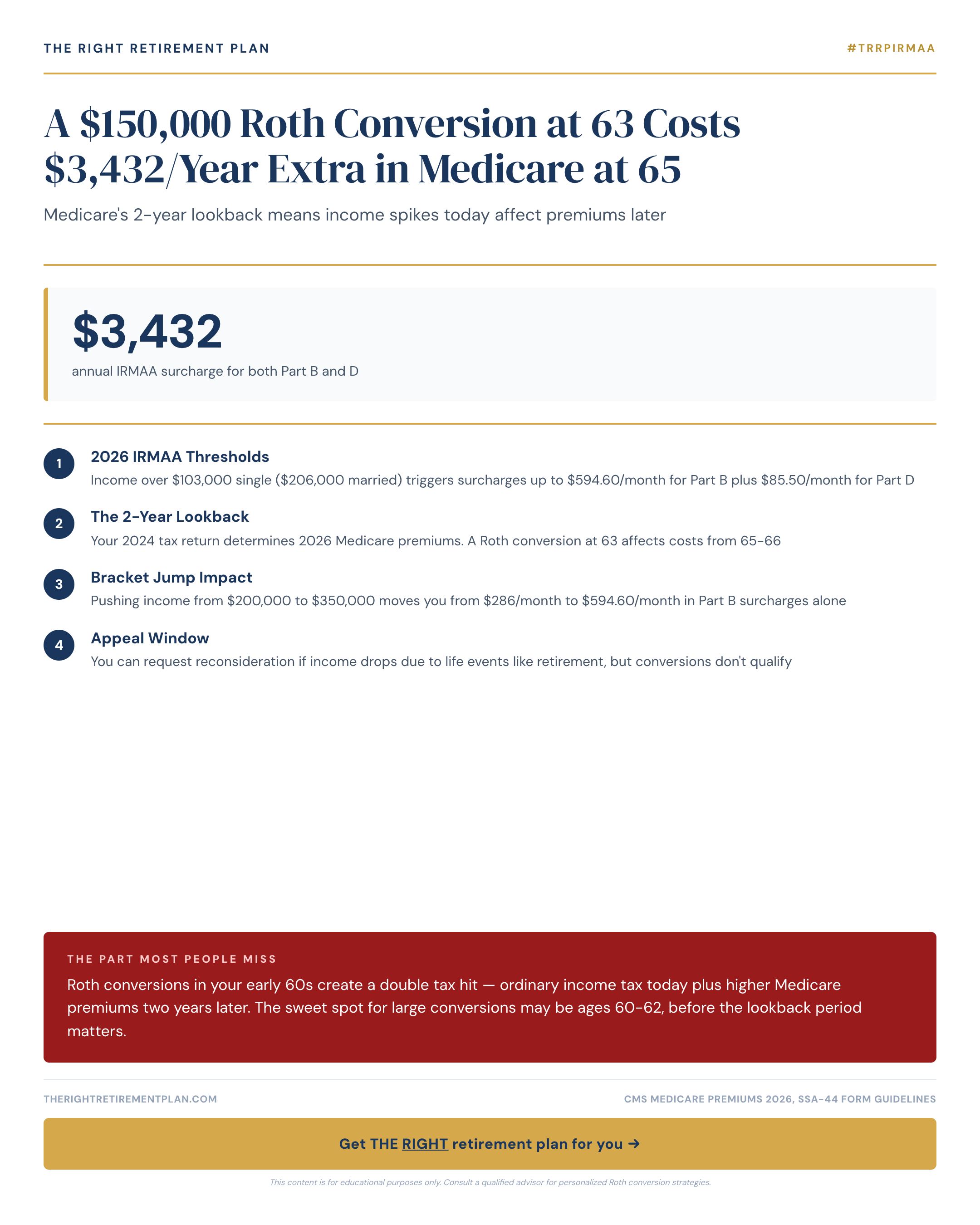
Here's the eye-opening reality: a $150,000 Roth conversion at age 63 adds approximately $3,432 per year to your Medicare premiums when you turn 65. That's real money subtracted from your conversion strategy's expected return—money that never appears in basic "pay taxes now vs. later" calculations.
The culprit is Medicare's two-year lookback system. Your 2024 income determines your 2026 premiums, creating a timing trap for Roth conversions that many retirees discover too late.
How IRMAA Turns Conversion Income Into Premium Surcharges
Medicare Part B and Part D premiums aren't fixed costs. The Social Security Administration uses your Modified Adjusted Gross Income from two years prior to determine what you pay.
When you execute a Roth conversion, the entire amount counts as ordinary income. A $150,000 conversion adds $150,000 to your MAGI—regardless of whether you actually spent that money.
For 2026, IRMAA thresholds create these monthly Part B premiums for individuals:
- Up to $106,000 MAGI: $185 (standard rate)
- $106,001–$133,000: $259.40 (+$74.40)
- $133,001–$167,000: $370.00 (+$185.00)
- $167,001–$200,000: $480.60 (+$295.60)
- $200,001–$500,000: $591.20 (+$406.20)
Part D adds additional surcharges ranging from $13.70 to $85.80 monthly.
Consider a Maryland retiree living on $60,000 annually from Social Security and pension income. Without conversions, they pay standard premiums. Execute a $150,000 Roth conversion strategy, and their MAGI jumps to $210,000—triggering $406.20 monthly in Part B surcharges alone.
Total annual increase: $4,874 for Part B plus approximately $890 for Part D surcharges. For married couples both on Medicare, double these amounts.
The Sweet Spot: Converting Before the Lookback Period
The two-year lookback creates an opportunity many retirees miss entirely. Convert at age 60-62, and the income spike affects Medicare premiums before you're actually enrolled.
Here's the timeline for someone retiring at 60:
- Age 60: Execute large Roth conversion
- Age 62: Would face elevated premiums if on Medicare—but you're not eligible yet
- Age 65: Enroll in Medicare with premiums based on age 63 income (post-conversion)
This timing advantage allows more aggressive conversions early in retirement when you have the most years for tax-free growth ahead. Each additional year of tax-free compounding typically adds 1-2% to total retirement wealth for moderate-income retirees.
The strategy requires careful cash flow planning since you need funds to pay conversion taxes without touching the converted amounts.
A retiree converting $150,000 at both age 63 and 64 faces elevated premiums for four consecutive years: ages 65-68. At roughly $5,200 annually in premium surcharges, that's over $20,000 in costs never captured by standard conversion analysis. This hidden expense can push the breakeven point years further into the future than expected.
Strategic Conversion Sizing
If you must convert after age 63, treat IRMAA brackets like tax brackets—fill up to the threshold, then stop. With $80,000 in base retirement income, you have $26,000 of "room" before hitting the first IRMAA cliff at $106,000.
Converting exactly $26,000 keeps you in standard premium territory while still moving money to tax-free status. Yes, it's smaller than a $150,000 conversion, but the effective cost is dramatically lower when you factor in avoided premium surcharges.
Advisors in the Annapolis area often recommend this bracket-aware approach over 10-15 years rather than massive conversions over 2-3 years. The result: potentially twice the total conversion capacity over your retirement.
For personalized guidance on Medicare planning strategies and Roth conversions, consider taking our Retire Ready Score to see how your current approach measures up.