How the Mega Backdoor Roth Works
If you're a high earner who's maxed out traditional retirement contributions, you might be missing a powerful tax strategy that could shift hundreds of thousands of dollars into tax-free growth territory.
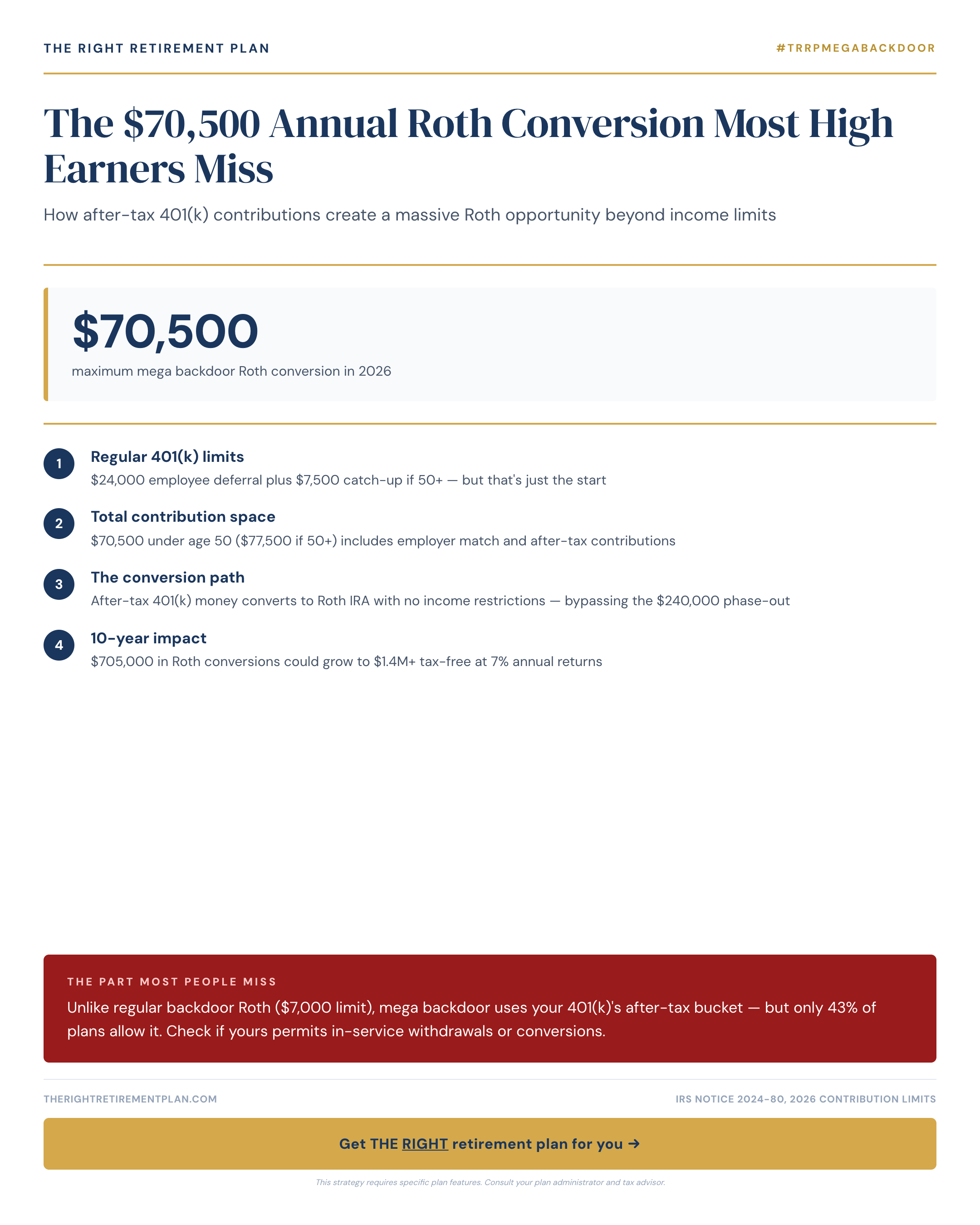
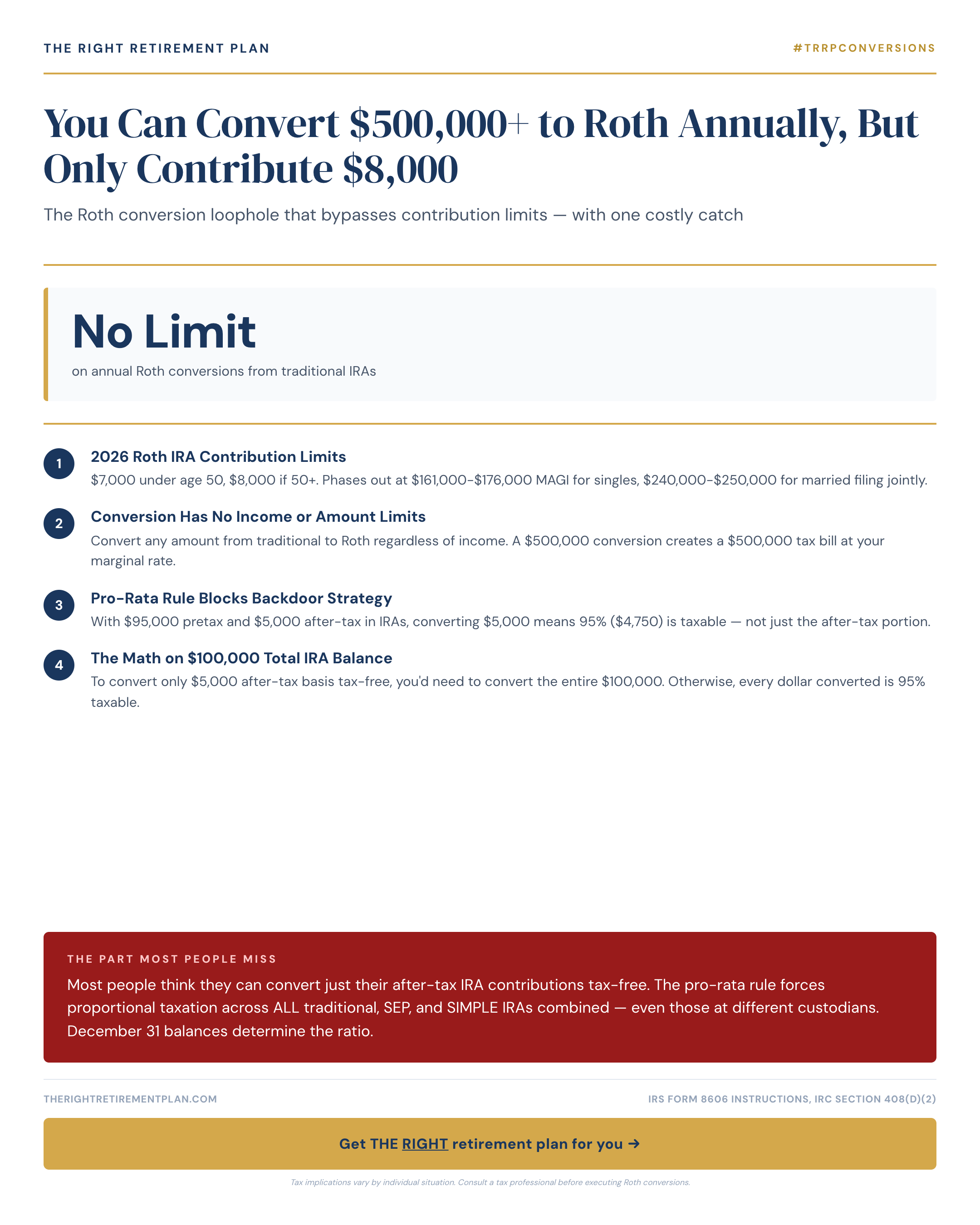
The mega backdoor Roth allows eligible participants to contribute up to $70,500 in after-tax dollars to their 401(k) and immediately convert those funds to Roth status in 2026. That's ten times larger than the standard backdoor Roth IRA limit of $7,000.
Here's the reality check: only 43% of employer 401(k) plans offer the specific provisions needed for this strategy, according to the Plan Sponsor Council of America. Even among those with access, most employees never use it because they don't know it exists.
The math is compelling. A Maryland executive earning $300,000 with a 4% employer match could potentially move $32,500 annually into tax-free Roth accounts using this strategy. Over a decade, that's $325,000 in contributions alone—plus all future tax-free growth.
The Two Critical Plan Features You Need
Your mega backdoor Roth strategy depends entirely on your employer's plan design. You need both of these features:
After-Tax Contribution Option
Your plan must allow voluntary after-tax contributions beyond the standard $23,500 elective deferral limit ($31,000 if you're 50+). These aren't Roth 401(k) contributions—they're a separate bucket that uses the remaining space up to the $70,000 total annual addition limit.
Conversion Mechanism
You need either in-service withdrawals to roll funds to a Roth IRA or in-plan conversions to your 401(k)'s Roth bucket. Without this, your after-tax contributions remain stuck earning taxable growth until you leave your job.
Check your Summary Plan Description or ask HR directly about these provisions. Many plans offer one feature but not both, which kills the strategy entirely.
Calculating Your Available Space
Your mega backdoor Roth capacity follows a simple formula:
Available Space = $70,000 − Your Elective Deferrals − Employer Contributions
For 2026, here's how it works for different scenarios:
- Age 45, $200k salary, 6% match: $34,500 available space
- Age 55, $400k salary, 3% match: $34,500 available space
- Age 62, enhanced catch-up eligible: Up to $34,500 available space
The key insight: higher earners don't necessarily get more space. Your employer's match and your own contribution rate determine the gap.
Convert frequently—quarterly or even per paycheck—to minimize taxable earnings on your after-tax contributions before conversion.
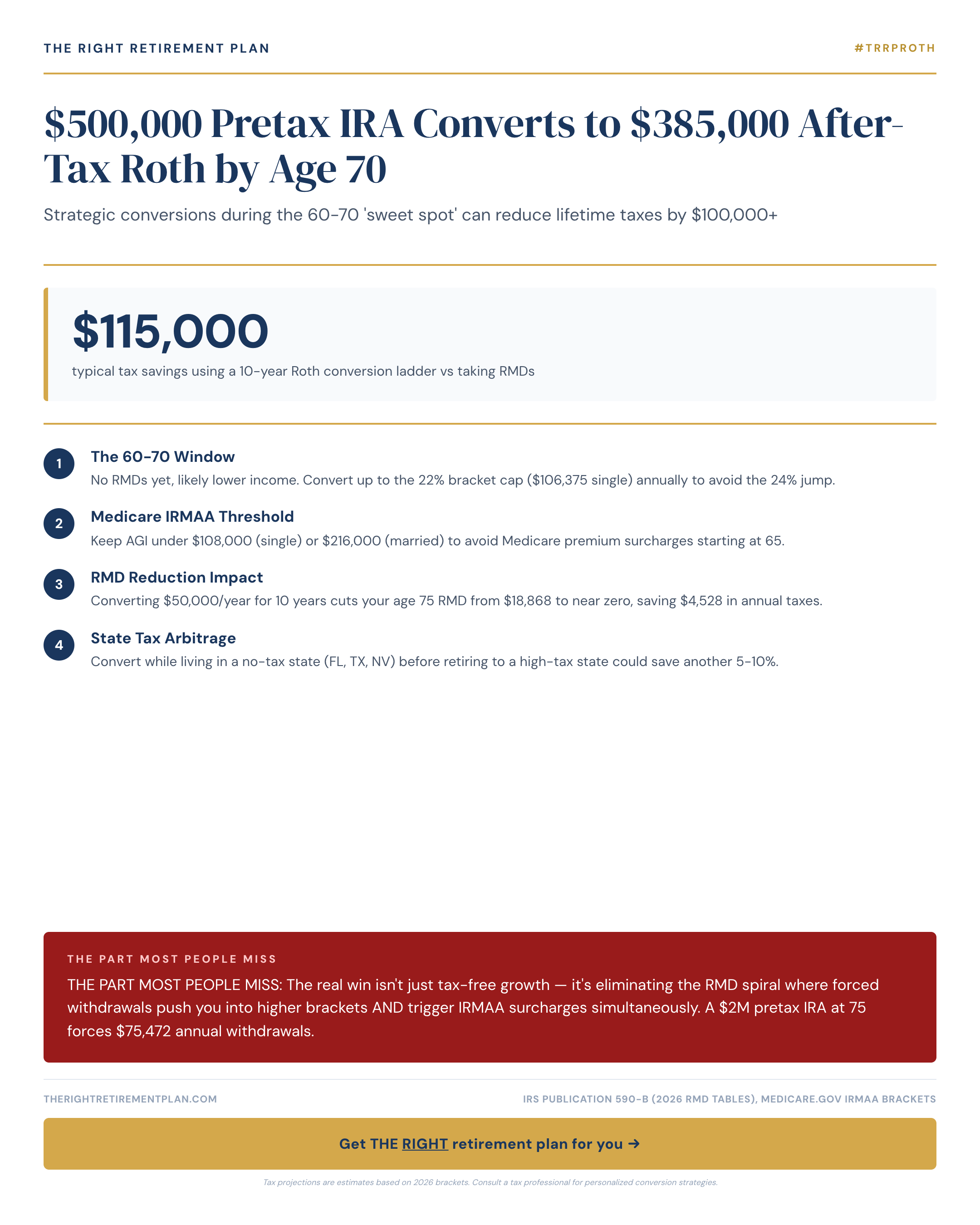
Consider this: substantial pre-tax 401(k) balances create Required Minimum Distributions that often push retirees into higher brackets than expected. For couples in Annapolis and nationwide, this can trigger Medicare IRMAA surcharges starting at $212,000 in modified adjusted gross income for 2026, or cause Social Security benefits to become taxable.
Roth dollars don't count toward RMDs and won't push you into these costly thresholds. This isn't about predicting future tax rates—it's about creating flexibility to manage your tax situation in retirement.
If you're eligible for this strategy but unsure how it fits your broader retirement picture, consider taking our Retire Ready Score for personalized guidance on optimizing your tax-advantaged savings approach.