The Three Bucket Strategy: Organizing Your Retirement Portfolio
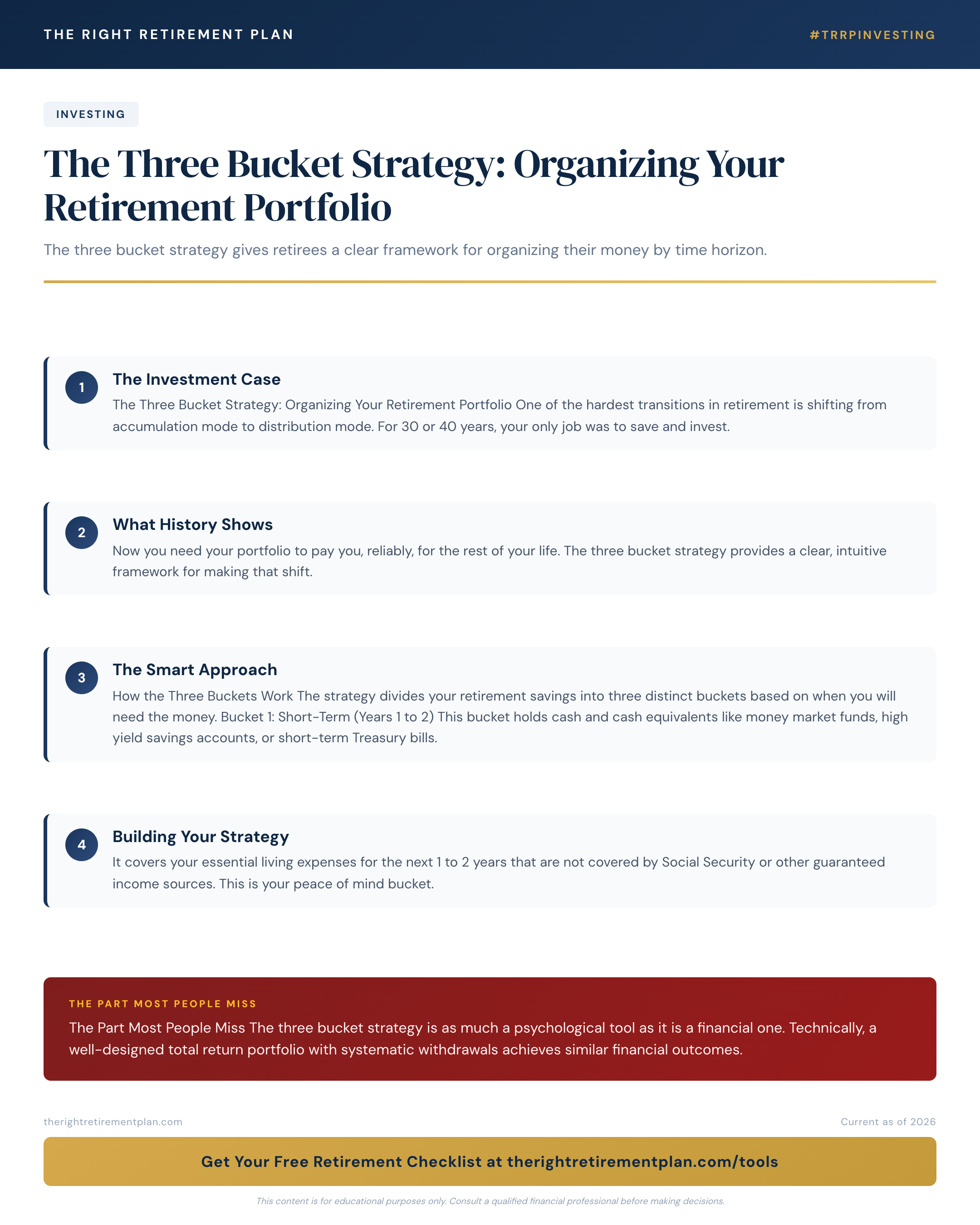
One of the hardest transitions in retirement is shifting from accumulation mode to distribution mode. For 30 or 40 years, your only job was to save and invest. Now you need your portfolio to pay you, reliably, for the rest of your life. The three bucket strategy provides a clear, intuitive framework for making that shift.
How the Three Buckets Work
The strategy divides your retirement savings into three distinct buckets based on when you will need the money.
Bucket 1: Short-Term (Years 1 to 2)
This bucket holds cash and cash equivalents like money market funds, high yield savings accounts, or short-term Treasury bills. It covers your essential living expenses for the next 1 to 2 years that are not covered by Social Security or other guaranteed income sources.
This is your peace of mind bucket. No matter what the stock market does tomorrow, next month, or next year, your immediate needs are covered.
Bucket 2: Medium-Term (Years 3 to 7)
This bucket holds intermediate-term bonds, bond funds, and possibly certificates of deposit. Its job is to refill Bucket 1 as you spend it down, and to provide moderate growth with limited volatility.
High quality bond funds, Treasury Inflation Protected Securities (TIPS), and short-to-intermediate bond ladders are common holdings here. You want stability and some income, not aggressive growth.
Bucket 3: Long-Term (Years 8 and Beyond)
This is your growth engine. Bucket 3 holds a diversified portfolio of stocks, including domestic and international equities, possibly with a small allocation to real estate or other growth-oriented assets.
Because you will not need this money for 8 or more years, you can ride out market corrections and bear markets. History shows that stock market downturns, even severe ones, typically recover within 3 to 5 years. Your time horizon in Bucket 3 gives you that runway.
How the Buckets Refill
The strategy works as a cascade. As you spend down Bucket 1, you replenish it from Bucket 2. As Bucket 2 depletes, you refill it from Bucket 3 during periods of strong market performance.
The key discipline is this: you never refill from Bucket 3 during a bear market. You draw from Buckets 1 and 2 instead, giving Bucket 3 time to recover. This is how you avoid the devastating impact of selling stocks at the worst possible time.
Some retirees set specific triggers for refilling, such as rebalancing annually or topping off Bucket 1 whenever Bucket 3 reaches a new high. The exact method matters less than the commitment to never raiding your long-term growth assets during downturns.
Sizing Your Buckets
The right allocation depends on your spending needs, other income sources, and risk tolerance. As an example, if you spend $60,000 per year and receive $25,000 from Social Security, your portfolio needs to cover $35,000 annually. That means roughly $70,000 in Bucket 1 (2 years), $175,000 in Bucket 2 (5 years), and the remainder in Bucket 3. This gives you 7 years of runway before touching your stocks.
When the market drops 30%, a retiree with a single blended portfolio sees their entire net worth decline and often makes emotional decisions. A retiree using the bucket strategy looks at Bucket 1, sees two years of spending safely in cash, and can afford to be patient.
The ability to do nothing during a crisis is one of the most valuable skills in retirement investing. The three bucket strategy makes doing nothing much easier.
Take the Next Step
Ready to see how the bucket strategy might work with your retirement savings? Take the free retirement quiz at therightretirementplan.com/quiz to get a personalized starting point.
This content is for educational purposes only and should not be considered personalized investment advice. Consult a qualified financial professional before making investment decisions.