Dividend Investing in Retirement: Reliable Income or False Promise?
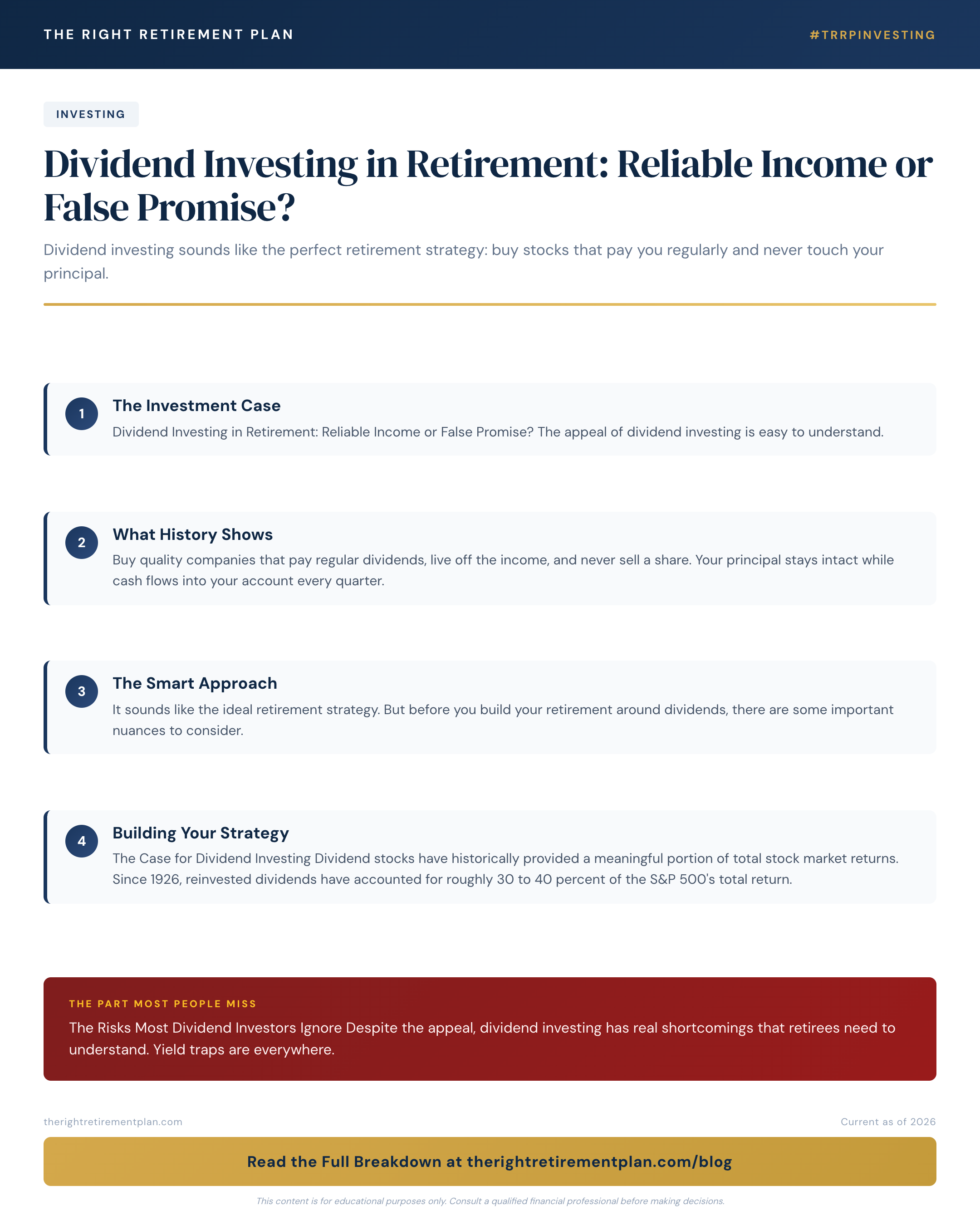
The appeal of dividend investing is easy to understand. Buy quality companies that pay regular dividends, live off the income, and never sell a share. Your principal stays intact while cash flows into your account every quarter. It sounds like the ideal retirement strategy.
But before you build your retirement around dividends, there are some important nuances to consider.
The Case for Dividend Investing
Dividend stocks have historically provided a meaningful portion of total stock market returns. Since 1926, reinvested dividends have accounted for roughly 30 to 40 percent of the S&P 500's total return.
Companies that consistently pay and grow dividends tend to be financially stable, well-managed businesses. The Dividend Aristocrats, companies that have raised their dividends for at least 25 consecutive years, include many household names that have weathered recessions, financial crises, and market panics.
For retirees, the psychological benefit is real. Receiving regular income without selling shares feels sustainable and avoids the anxiety of watching your portfolio balance decline.
The Risks Most Dividend Investors Ignore
Despite the appeal, dividend investing has real shortcomings that retirees need to understand.
Yield traps are everywhere. A stock with an unusually high dividend yield, say 8% or more, is often signaling trouble. The price has dropped because the market expects the dividend to be cut. Chasing yield is one of the most common and costly mistakes retirees make.
Dividends are not guaranteed. During the 2008 financial crisis, more than 800 U.S. companies cut or eliminated their dividends. Even blue chip companies can reduce payouts when business deteriorates. Depending on dividends as your sole income source leaves you vulnerable.
Concentration risk is real. Building a dividend portfolio often means overweighting certain sectors like utilities, financials, and consumer staples while underweighting growth sectors like technology and healthcare. This lack of diversification can hurt both returns and risk management.
Tax inefficiency in taxable accounts. Dividends are taxable in the year they are paid, whether you need the money or not. In a total return approach, you control when you realize gains, giving you more tax flexibility.
Total Return vs. Income Approach
Financial researchers generally favor a "total return" approach over a pure income approach. The total return method focuses on growing the overall portfolio through both appreciation and income, then selling shares as needed for living expenses.
Mathematically, there is no difference between receiving a $1,000 dividend and selling $1,000 worth of shares. In both cases, your net worth decreases by $1,000 after the payment. The dividend just makes it feel different.
A total return approach gives you more diversification, better tax control, and the same income capability. It simply requires the discipline to sell shares systematically rather than relying on dividends to arrive in your account.
Finding the Middle Ground
You do not have to choose one approach exclusively. Many successful retirees use a blended strategy:
Hold broad market index funds that naturally include dividend-paying companies. Let dividends contribute to your income without forcing your portfolio into an artificial yield target. Supplement with systematic withdrawals when dividends do not cover your full spending needs.
This approach captures the benefits of dividend income without the concentration risk and yield chasing that pure dividend strategies invite.
What actually protects your principal is proper asset allocation, diversification, and a sustainable withdrawal rate. Those fundamentals matter far more than whether your income arrives as dividends or as proceeds from selling shares.
Take the Next Step
Want to evaluate whether your retirement income strategy is built on solid ground? Explore the free planning tools at therightretirementplan.com/tools to stress test your approach.
This content is for educational purposes only and should not be considered personalized investment advice. Consult a qualified financial professional before making investment decisions.