How to Invest a Lump Sum at Age 60: Dollar Cost Averaging vs. All at Once
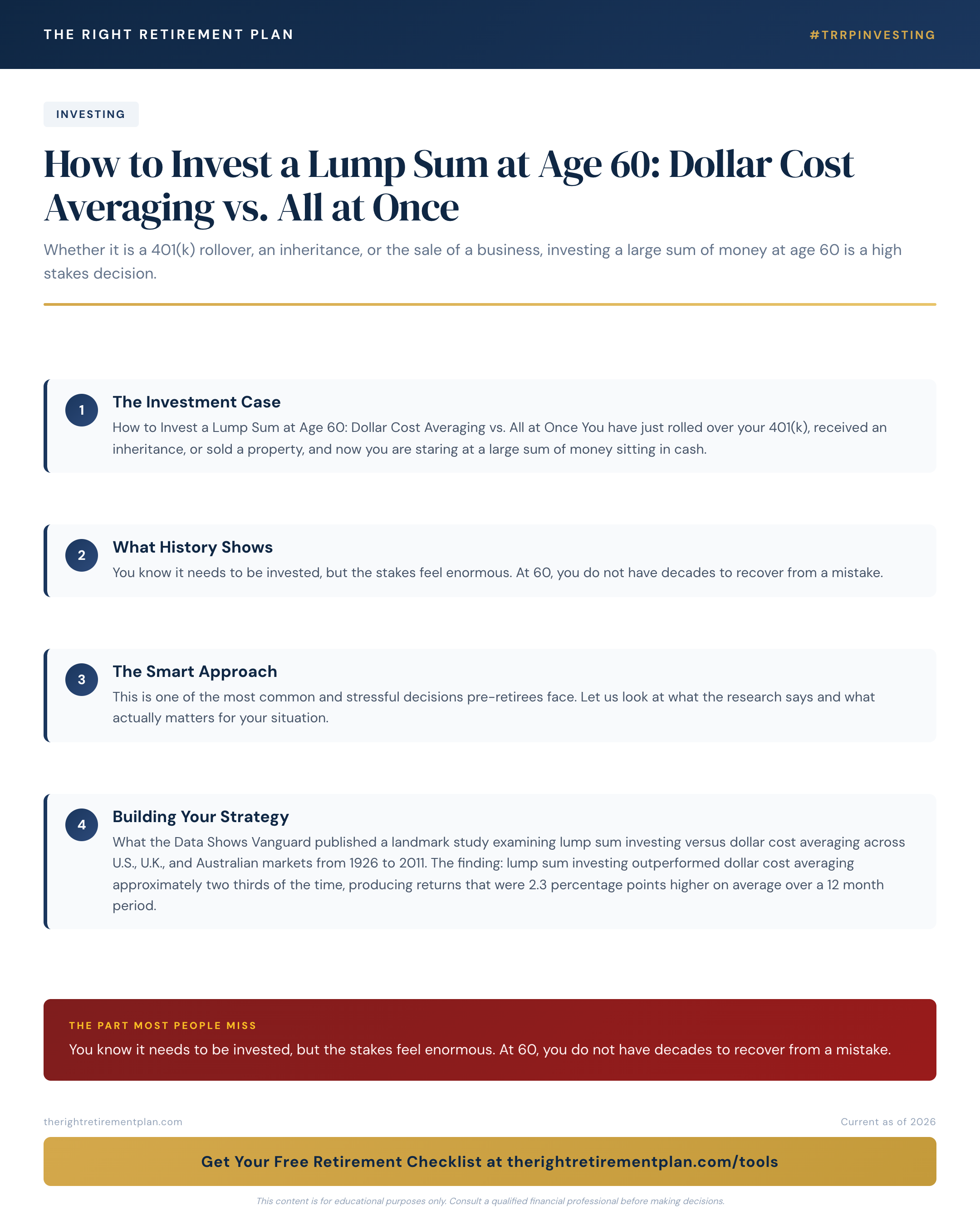
You have just rolled over your 401(k), received an inheritance, or sold a property, and now you are staring at a large sum of money sitting in cash. You know it needs to be invested, but the stakes feel enormous. At 60, you do not have decades to recover from a mistake.
This is one of the most common and stressful decisions pre-retirees face. Let us look at what the research says and what actually matters for your situation.
What the Data Shows
Vanguard published a landmark study examining lump sum investing versus dollar cost averaging across U.S., U.K., and Australian markets from 1926 to 2011.
The finding: lump sum investing outperformed dollar cost averaging approximately two thirds of the time, producing returns that were 2.3 percentage points higher on average over a 12 month period.
The reason is straightforward. Markets go up more often than they go down. By investing immediately, you put your money to work in a market that historically rises roughly 7 out of every 10 years.
Why the Math Does Not Tell the Whole Story
If lump sum investing wins two thirds of the time, it also loses one third of the time. For a 60 year old with a $500,000 rollover, being on the wrong side can feel catastrophic.
Imagine investing your entire rollover on January 1, 2022 and watching it lose 16 to 20 percent over the next year. Mathematically, you would recover. Emotionally, you might panic, sell at the bottom, and lock in permanent losses.
Dollar cost averaging reduces regret. It gives you time to adjust and prevents the worst scenario of investing everything at a market peak.
A Practical Framework for Lump Sum Decisions
Rather than choosing strictly between all at once or gradual investing, consider these factors:
How much of the lump sum will you need in the next 2 to 3 years? That portion should go into cash or short-term bonds regardless, not into the stock market.
What is your overall asset allocation target? If the lump sum is going into a diversified portfolio of stocks and bonds, the risk is already moderated. You are not putting everything into stocks.
How would you react to an immediate 20% decline? Be honest. If a significant loss would cause you to sell everything, dollar cost averaging over 6 to 12 months is the smarter choice for you, even if the math slightly favors going all in.
How large is the lump sum relative to your total wealth? If you have a $2 million portfolio and are investing a $100,000 inheritance, the lump sum is only 5% of your total assets. Invest it immediately. If it represents the majority of your savings, a more gradual approach makes sense.
A Middle Path That Works
Many financial planners recommend a compromise: invest 50% immediately and dollar cost average the remaining 50% over 3 to 6 months. This captures most of the statistical advantage while providing emotional cushion. Another approach is to invest the bond portion immediately and dollar cost average only the equity portion.
If you choose to dollar cost average, set up automatic transfers on a fixed schedule and do not deviate. The strategy only works if you complete it.
Take the Next Step
Facing a major investment decision as you approach retirement? Take the free retirement readiness quiz at therightretirementplan.com/quiz to get clarity on your next move.
This content is for educational purposes only and should not be considered personalized investment advice. Consult a qualified financial professional before making investment decisions.