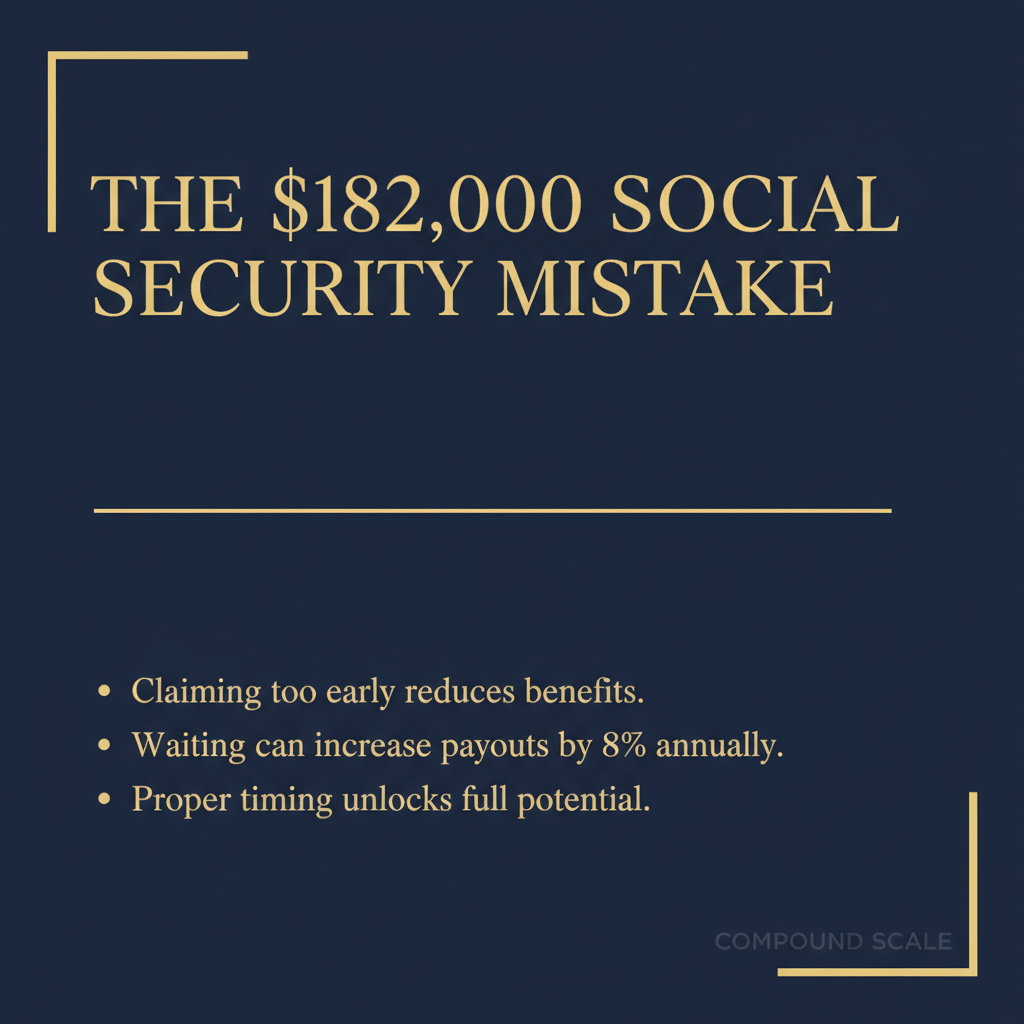
The average American couple leaves $182,000 on the table by claiming Social Security at the wrong time. According to research from United Income, the majority of retirees claim their benefits at a financially suboptimal age, costing themselves tens of thousands to hundreds of thousands of dollars in lifetime income.
What makes this particularly painful is that Social Security claiming decisions are largely irreversible. Yet 38% of Americans still claim at 62—the earliest possible age—accepting permanent reductions to their monthly checks. For someone whose full retirement age benefit would be $2,500 per month, claiming at 62 drops that to roughly $1,750. Every month. For life.
The Math Behind the 77% Difference
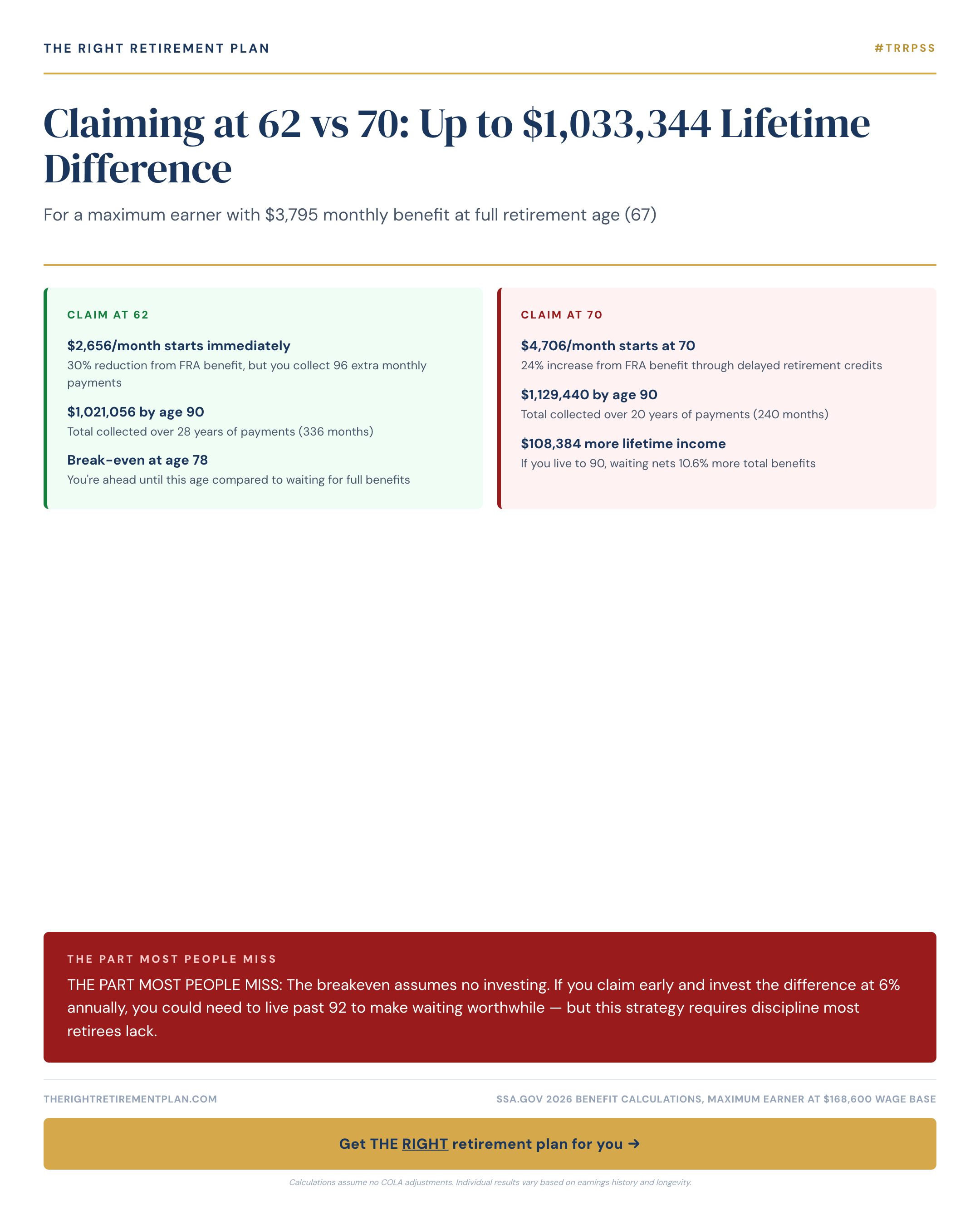
For someone born in 1960 or later, full retirement age (FRA) is 67. The Social Security Administration built in powerful incentives to delay claiming. If your FRA benefit is $3,000 per month, here's what happens at different claiming ages in 2026:
- Age 62: $2,100/month (30% permanent reduction)
- Age 67 (FRA): $3,000/month (full benefit)
- Age 70: $3,720/month (24% increase via delayed retirement credits)
The difference between claiming at 62 versus 70 represents a 77% higher monthly benefit—for the rest of your life. Over a 25-year retirement, that's roughly $486,000 more in total
Social Security benefits.
Delayed retirement credits add 8% per year between FRA and age 70. That's a guaranteed 8% annual return that's inflation-adjusted and backed by the federal government. Finding a comparable guaranteed return in today's market is essentially impossible.
The early claiming reduction isn't temporary. The SSA reduces benefits by approximately 6.67% per year for the first three years before FRA, then 5% per year for additional early years. These reductions compound over time through their effect on survivor benefits.
Why Married Couples Need Coordination Strategies
For married couples, Social Security optimization isn't two separate decisions—it's one coordinated strategy. The spousal benefit allows a lower-earning spouse to receive up to 50% of the higher earner's full retirement age benefit.
But here's the critical piece: when one spouse dies, the surviving spouse receives the higher of the two benefits, not both. According to SSA data, one spouse in a 65-year-old couple has a 50% chance of living past 90.
This creates a crucial implication: the higher earner's claiming decision directly determines the survivor benefit. If they claim at 62 and receive reduced benefits, that becomes the maximum survivor benefit. If they delay until 70, the surviving spouse receives that higher amount instead.
Consider Maryland retirees where one spouse has an FRA benefit of $3,200. If they claim at 62, the survivor benefit is approximately $2,240/month. If they delay until 70, the survivor benefit becomes $3,968/month. Over 10 years of widowhood, that's a difference of more than $207,000.
Strategic Claiming for Maximum Household Income
The optimal approach for many couples involves having the higher earner delay as long as possible while the lower earner claims earlier. This provides household income during the gap years while maximizing the eventual survivor benefit.
Example coordination strategy:
- Lower-earning spouse claims at 64 for reduced but immediate benefits
- Higher-earning spouse delays until 70 for maximum monthly amount
- During the gap: household receives early benefits plus other income sources
- After age 70: household income increases substantially
- Long-term protection: survivor receives the maximum possible benefit
Financial advisors in the Annapolis area often see couples who analyzed their benefits individually rather than as a coordinated household strategy, missing significant optimization opportunities.
This reframe changes everything. The higher earner's decision isn't about their own break-even point—it's about protecting their spouse's income for years after they're gone. According to the United Income study, this coordination failure accounts for a significant portion of the $182,000 average loss.
Social Security timing is just one piece of a comprehensive retirement income strategy. If you're wondering how your current plan accounts for claiming coordination and longevity risk, consider taking our Retire Ready Score assessment for personalized guidance.