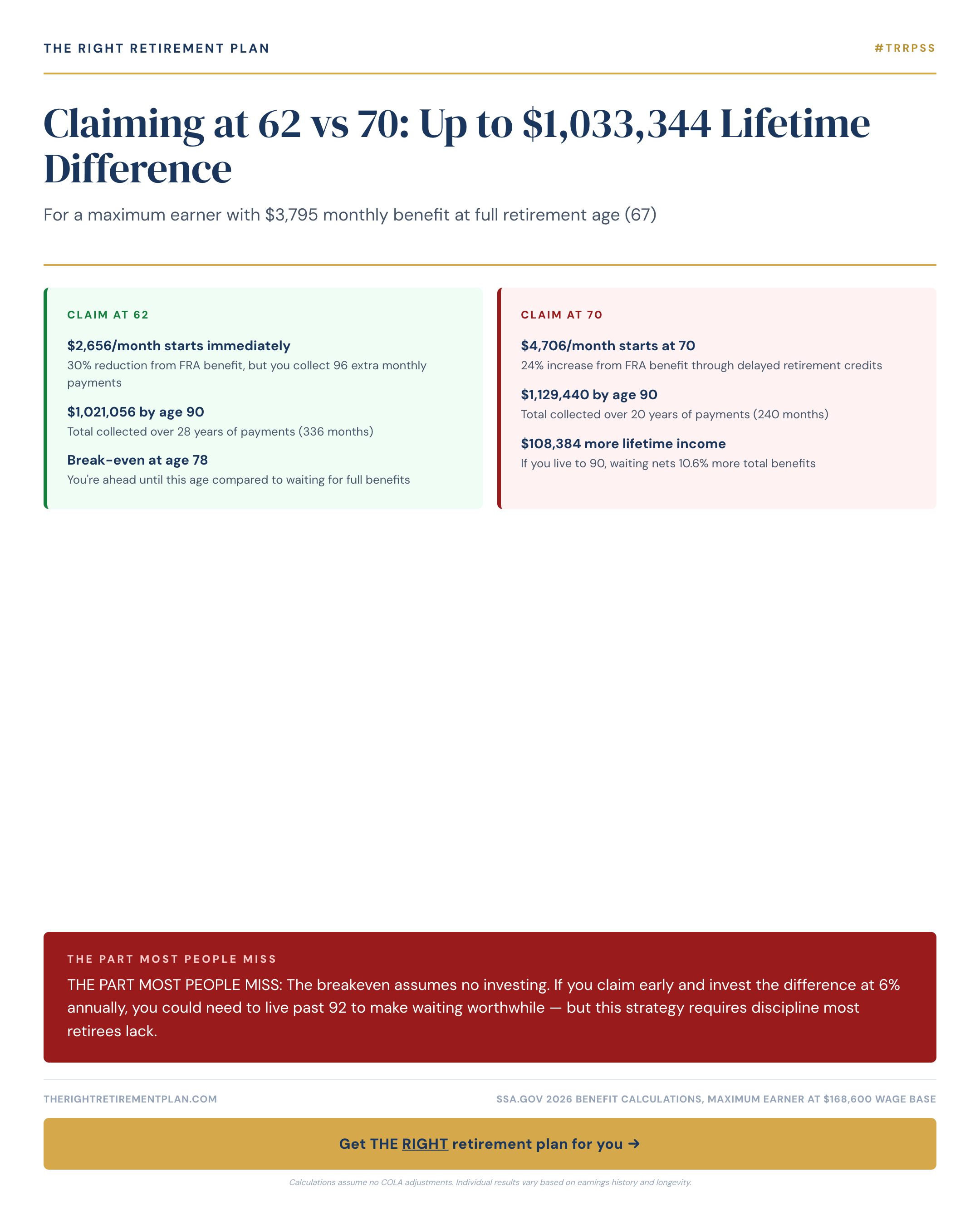
The decision of when to claim Social Security benefits represents one of the most significant financial choices in retirement planning. For maximum earners with a full retirement age benefit of $3,795 monthly, the timing difference between claiming at 62 versus 70 can result in a staggering lifetime variance of up to $1,033,344.
Understanding the Social Security Claiming Timeline
Social Security benefits are designed around your full retirement age, which is 67 for most current retirees. Claiming early at 62 triggers permanent reductions of approximately 30% to your monthly benefit. Conversely, delaying benefits until age 70 adds delayed retirement credits, boosting your monthly payment by roughly 32%.
For a maximum earner, this translates to dramatic monthly differences:
- Claiming at 62: approximately $2,657 monthly
- Claiming at 67: $3,795 monthly
- Claiming at 70: approximately $5,008 monthly
The cumulative effect over a 20-year retirement period creates the substantial lifetime difference. Maryland retirees and others in the Mid-Atlantic region often underestimate how these percentages compound over decades.
Investment Strategy Considerations
Many financial advisors suggest claiming early and investing the difference. This "claim and invest" strategy assumes you'll generate returns that exceed the guaranteed 8% annual increase Social Security provides for delayed claiming.
The mathematics seem compelling initially. If you claim at 62 and invest monthly payments at 6% annual returns, you're building a substantial portfolio. However, this approach requires consistent market performance and disciplined investing behavior.
The breakeven analysis typically shows you need to live past age 82-84 to benefit from delayed claiming, assuming no investment of early benefits.
Most retirees don't maintain aggressive investment portfolios after claiming benefits. They typically shift toward conservative investments or spend the money on living expenses, negating the theoretical investment advantage.
Making the Right Decision
Your optimal claiming strategy depends on multiple factors beyond simple mathematics. Health status, spousal benefits, other retirement income sources, and risk tolerance all influence the decision.
Consider your complete financial picture, including 401(k) balances, pension income, and healthcare costs. The "right" answer varies significantly based on individual circumstances.
If you want personalized guidance on optimizing your Social Security strategy within your complete retirement plan, take our free Retire Ready Score to see how your current approach measures up.