You spent decades building a $2 million 401(k). Now the IRS wants its share—on their schedule, not yours.
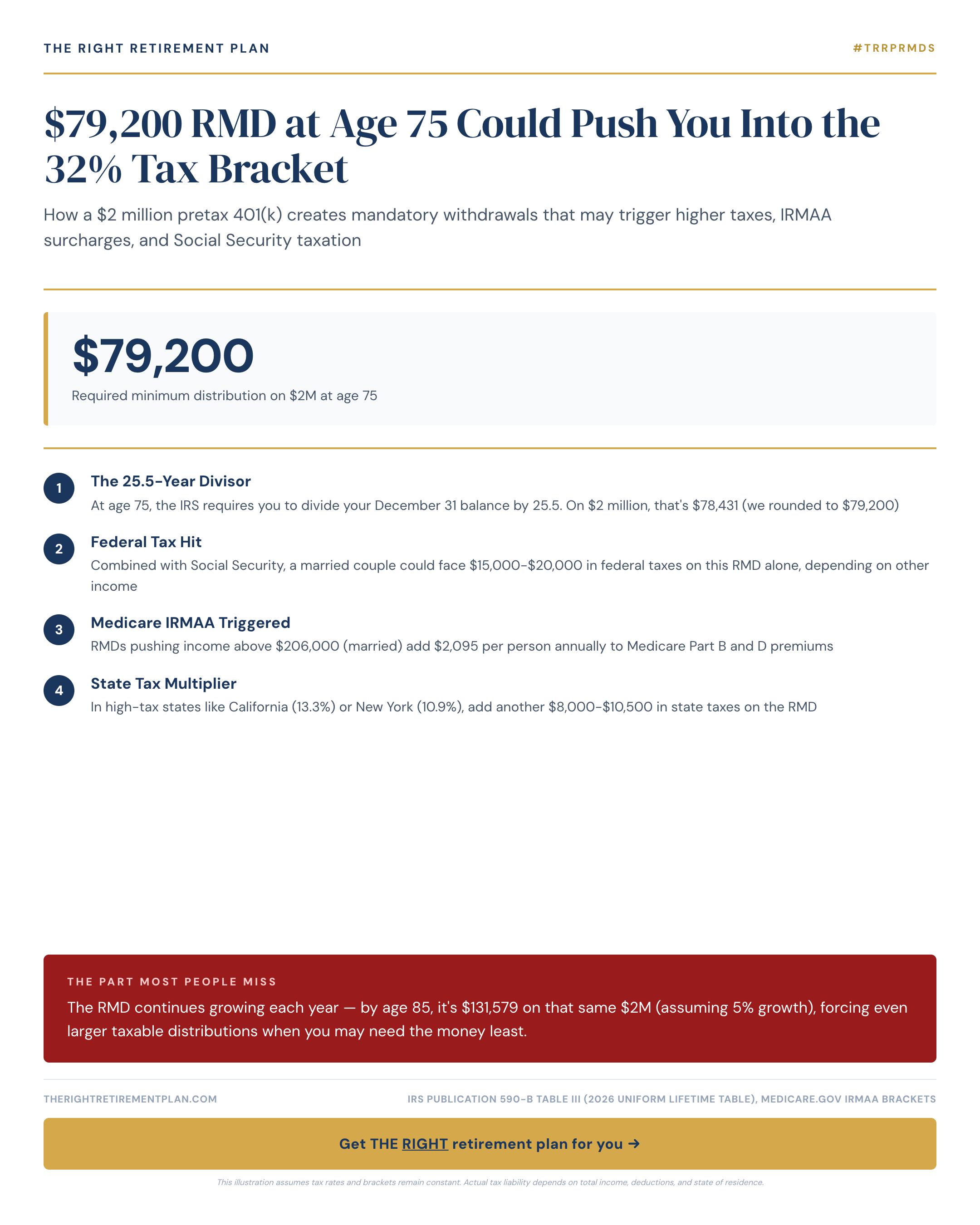
At age 75, that $2 million pretax retirement account generates a required minimum distribution of approximately $79,200. This single mandatory withdrawal could push a married couple from the 24% federal tax bracket into the 32% bracket, costing an additional $6,336 in federal taxes. But the bracket jump is just the beginning—that same income spike may trigger Medicare's Income-Related Monthly Adjustment Amount (IRMAA), adding $2,289 per year in additional premiums for a couple.
How RMD Math Creates Tax Bracket Creep
Required minimum distributions follow IRS life expectancy tables that force increasingly larger withdrawals as you age. For 2026, the Uniform Lifetime Table sets the divisor at 24.6 for age 75. A $2 million pretax balance divided by 24.6 equals roughly $81,300, though market fluctuations typically adjust this figure to around $79,200.
Here's where bracket creep becomes dangerous. For 2026, the 24% bracket for married filing jointly ends at $395,050, with the 32% bracket beginning immediately above that threshold. A couple with modest retirement income—$50,000 in Social Security benefits, $30,000 in pension income, and that $79,200 RMD—reports significant taxable income before considering other sources.
By age 85, assuming 5% average growth, that same account generates an RMD of approximately $131,579. The account grew, but so did the mandatory withdrawal percentage. The IRS divisor at 85 is just 16.0, meaning you must withdraw 6.25% of the balance annually—regardless of whether you need the money.
The Medicare IRMAA Multiplier Effect
Medicare's Income-Related Monthly Adjustment Amount operates as a stealth tax that compounds the damage from RMD-driven income spikes. For 2026, IRMAA thresholds for married couples filing jointly are:
- Standard premium: MAGI up to $212,000
- First surcharge tier: MAGI $212,001–$266,000 (adds $74/month per person)
- Second surcharge tier: MAGI $266,001–$332,000 (adds $185/month per person)
These thresholds are based on your tax return from two years prior. A large RMD in 2026 affects your Medicare premiums in 2028.
Crossing into the first IRMAA tier costs $1,776 annually for a couple. Cross into the second tier, and the annual surcharge jumps to $4,440. According to Employee Benefit Research Institute data, fewer than 8% of Medicare beneficiaries pay IRMAA surcharges—but that percentage rises sharply among households with significant pretax retirement assets.
Social Security's 85% Taxation Trap
Most retirees know Social Security benefits may be taxable, but fewer understand how RMDs can push more benefits into taxable territory. The Social Security Administration uses "combined income" to determine taxation:
- Below $32,000 (married filing jointly): Benefits are tax-free
- $32,000–$44,000: Up to 50% of benefits are taxable
- Above $44,000: Up to 85% of benefits are taxable
Many Maryland retirees discover this harsh reality when their first RMD pushes combined income well above $44,000. On $47,424 in annual benefits for a couple, 85% taxation means $40,310 added to taxable income—creating an additional $9,674 in federal taxes at the 24% bracket.
Strategic Planning Approaches
Several strategies may help manage required minimum distribution impact:
Roth conversions before RMDs begin can reduce future mandatory withdrawals. Converting pretax dollars between retirement and age 73 creates taxable income now but eliminates future RMDs on converted amounts.
Qualified Charitable Distributions allow taxpayers over 70½ to direct up to $105,000 annually from IRAs directly to charities. These distributions satisfy RMD requirements without adding to taxable income.
Asset location optimization involves holding tax-efficient investments in taxable accounts while keeping tax-inefficient assets in retirement accounts to reduce overall tax drag.
Understanding how RMDs interact with your specific situation requires knowing where you stand today. If you want personalized guidance on managing these retirement tax challenges, consider taking our Retire Ready Score assessment.