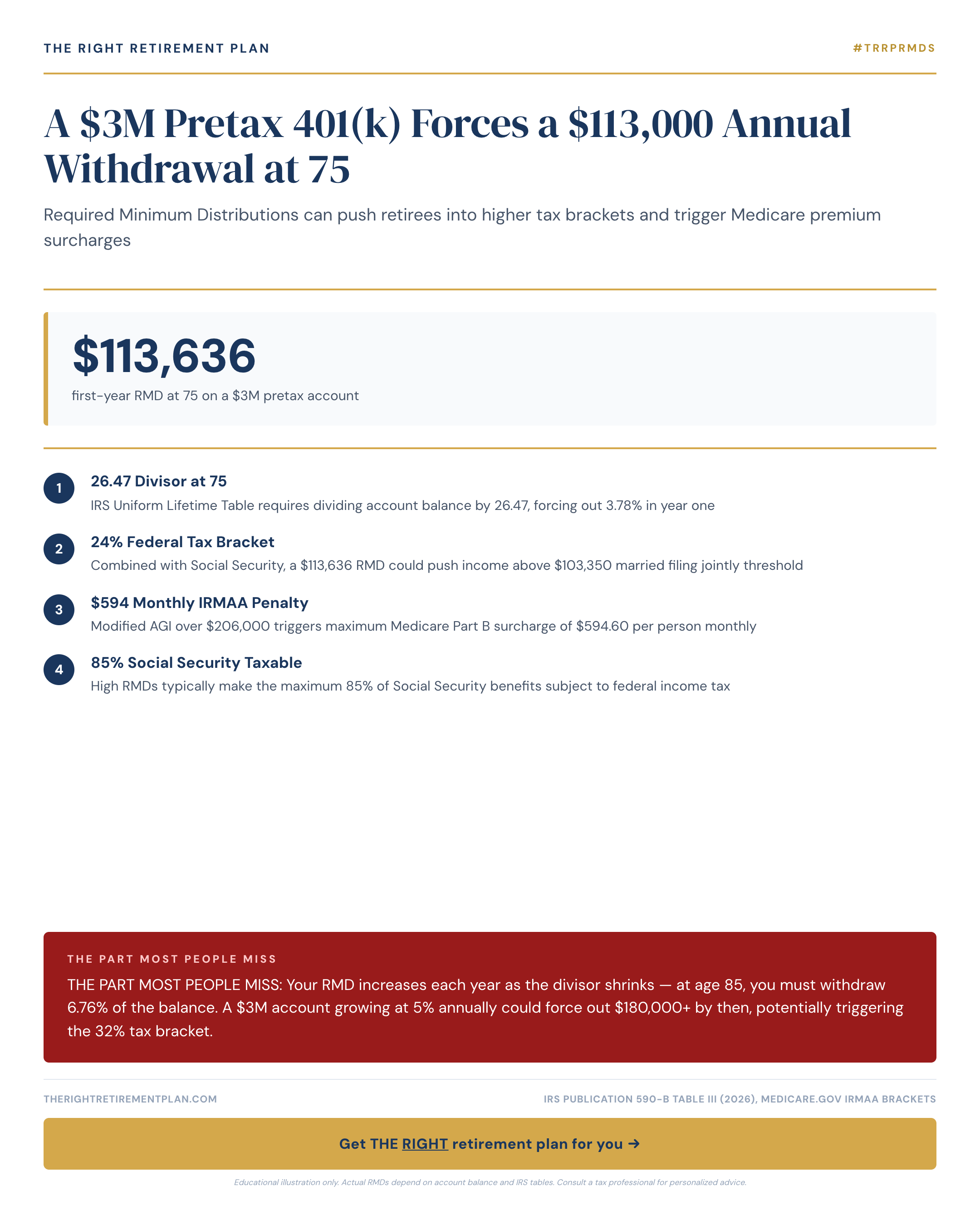
You spent decades building that $3 million 401(k) balance through disciplined saving and compound growth. But here's what the accumulation phase never warned you about: the IRS has been waiting patiently for their cut through Required Minimum Distributions.
At age 75, a $3 million pretax 401(k) triggers an RMD of approximately $131,000—money you must withdraw whether you need it or not. That forced income doesn't just create a tax bill; it can push you into higher brackets, trigger Medicare surcharges, and make more of your Social Security taxable.
How Required Minimum Distributions Actually Work
Required Minimum Distributions follow a straightforward formula: divide your December 31 account balance by the IRS life expectancy factor for your age. The challenge is that this divisor shrinks every year, forcing out an ever-larger percentage of your savings.
For 2026, the IRS Uniform Lifetime Table sets key divisors at:
- Age 73: 24.6 (4.07% withdrawal rate)
- Age 75: 22.9 (4.37% withdrawal rate)
- Age 80: 18.7 (5.35% withdrawal rate)
- Age 85: 14.8 (6.76% withdrawal rate)
Using the age-75 divisor: $3,000,000 ÷ 22.9 = $131,004
Here's what catches many Maryland retirees off guard: these percentages keep climbing even if your portfolio grows. By age 85, you're forced to withdraw nearly 7% annually—regardless of market conditions or spending needs.
The Tax Bracket Cascade Effect
A $131,000 RMD doesn't exist in isolation—it stacks on top of your other retirement income. For married couples filing jointly in 2026, the federal tax brackets are projected to be:
- 12%: $23,851–$96,950
- 22%: $96,951–$206,700
- 24%: $206,701–$394,600
- 32%: $394,601–$501,050
Total taxable income: $131,000 (RMD) + $40,800 (taxable Social Security) = $171,800
After the 2026 standard deduction for seniors ($32,300), you're looking at ~$139,500 in taxable income—landing you solidly in the 22% bracket in year one alone.
Medicare's Hidden Tax: IRMAA Surcharges
Medicare's Income-Related Monthly Adjustment Amount adds another layer of cost. For 2026, IRMAA thresholds for married couples are projected to be:
- $212,001–$266,000: +$1,776 annually per couple
- $266,001–$332,000: +$4,440 annually per couple
- $332,001–$398,000: +$7,094 annually per couple
Strategies to Reduce RMD Impact
While you can't eliminate Required Minimum Distributions entirely, several approaches may help manage their long-term impact:
Roth Conversions Before RMDs Begin: Converting pretax dollars to Roth accounts triggers taxes now but removes those funds from future RMD calculations. The key is converting during lower-income years when you have room in your current tax bracket.
Qualified Charitable Distributions: If you're 70½ or older, you can transfer up to $105,000 annually (2026 limit) directly from your IRA to qualified charities. These count toward your RMD but don't appear as taxable income.
Strategic Withdrawal Sequencing: Rather than following the traditional "taxable first, tax-deferred last" approach, some retirees benefit from tapping pretax accounts earlier to reduce the balance subject to future RMDs.
The math is unforgiving, but understanding it early gives you options. If you're wondering how Required Minimum Distributions might affect your specific retirement timeline, consider taking our Retire Ready Score for personalized insights into your planning priorities.